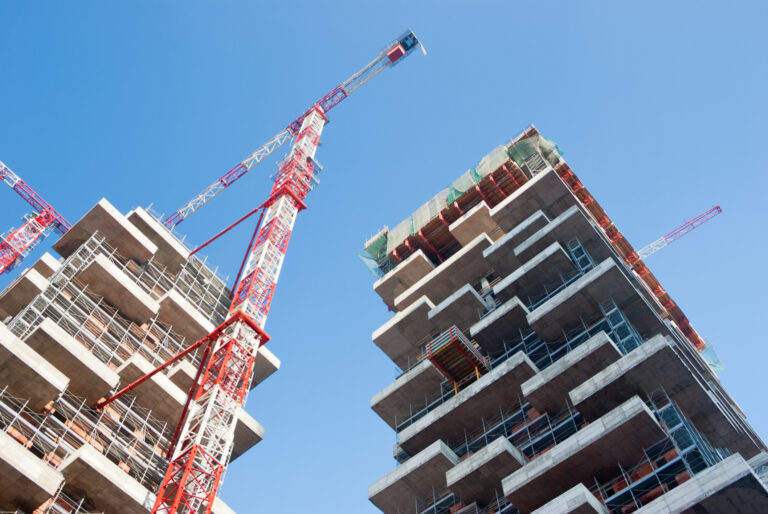
Within commercial real estate finance, commercial project finance is a specialized area that focuses on providing the necessary financial resources for the development of new real estate projects. Obtaining these funds can be complex for project developers, as lenders, depending on market cycles and their own financing criteria, place different requirements on borrowers before project finance can be approved or paid out.
Basics of Project Financing Situations for Project Developers
The background to the stricter criteria is often particular uncertainties in project development, such as higher construction costs, extended approval periods by authorities or imponderables that arise during the construction phase. Because new construction projects involve significant risks, lenders and investors must consider various factors before approving financing. These typically include the feasibility of the project, the experience of the project developer, market demand for the constructed property and general economic conditions, such as the current interest rate market. Lenders and investors usually review the scope of the project based on detailed plans, cost calculations and planned budgets, as well as the time frames for completion.
- Commercial mortgages are used for construction preparation, but primarily for the implementation of extensive building construction measures, whereby the release of funds is subject to strict disbursement conditions.
- Bridge financing is generally used for short-term financing needs in large new construction projects. A bridge loan can be used for a purchase, for measures to prepare for building construction, but also to cover unexpected expenses in the project.
- Financing prior to construction can include costs for the purchase of land or its development in advance of building projects or cover any costs that may be incurred to create building rights.
The valuation of the new building to be completed is of crucial importance for commercial project financing, as it determines the amount of funds required and the repayment of the capital borrowed from the expected income from the project. Lenders typically finance large new construction projects in tranches, with each tranche being released only after defined milestones along the verifiable construction progress have been reached. Developers and project managers can examine a variety of different financing options for their projects, and these projects are often structured with different lenders and sources of capital and financing products, e.g. through bank loans, equity, but also more complex instruments such as mezzanine financing or privately placed subordinated bonds. Each financing option has its advantages and disadvantages, and the choice depends largely on the size of the project, the duration of the construction work and market conditions.
Important Key Figures and Terms for Financing Commercial Building Projects
Loan-to-Value or Mortgage Lending Value (LTV) and Loan-to-Cost (LTC): Loan to Value (LTV) refers to the amount of the loan relative to the value of the property being constructed. For example, an LTV of 70 percent means that the lender finances 70 percent and the project developer 30 percent of the property value through equity or other sources of financing. The LTC refers to the amount of the loan relative to the construction costs. An LTC of 80 percent means that the lender finances 80 percent of the construction costs and the developer 20 percent. The LTC is important because it takes into account all project costs and provides a more comprehensive overview of the likelihood of additional financing being required due to cost variances along the construction phase.
Developer margin: The developer's margin is the potential profit for the project developer from the conclusion and complete sale of all units created in the building projects after deduction of all costs. For example, if the total project costs, including financing costs, amount to 10 million euros and the sales revenue is 12 million euros, the developer margin is 2 million euros or 20 percent of the total project costs. A healthy developer margin is important for both potential lenders and the project developer, in order to have a buffer for unexpected cost overruns during the construction phase.
Pre-sales rate: The pre-sales rate refers to the percentage of units sold from the building projects before the start of the construction phase. A common pre-sales rate required by lenders is around 30 percent of the total sales volume. This requirement serves to reduce the overall project risk by demonstrating strong market demand for the units to be built and gives lenders additional security through the income that is already flowing in before further funds are released for the construction phase.
Progress payments based on construction progress: The difference between a developer contract and an ordinary real estate purchase agreement for an existing property is that the purchased building or apartment is not yet completed. In this case, especially in consumer law, the legislator strikes a balance between the security needs of a buyer who does not want to pay the entire purchase price before completion and the project developer who has to finance the construction of the building. This is achieved through phased payments and installments. The legal basis for this is the German Makler- und Bauträgerverordnung. For example, funds are usually released and drawn down first for the purchase of the land, then for the completion of the foundations, the shell of the building, on completion of the main interior work and after final acceptance. This gives lenders control during the construction phase while still providing developers with structured access to liquidity.